miércoles, 8 de abril de 2020
Episode 20: The Game From Beyond The Grave Is Live!
sábado, 28 de marzo de 2020
Austro-Hungarian Vindow Vasher
Gobliins 2 - Final Rating
I am a bit torn about Gobliins 2. I began playing it with great expectations. The second game in the Gobliins-series showed clear improvements over its predecessor, being easier to play and fairer, while still retaining the wackiness of the first game. The more I played, the more irritated I became, when the game wouldn't just stop. I felt that the producers had tried to cram a bit too much into the game, that there was too much of a repetition of similar themes and puzzles and that the whole would have just improved from cutting away some of the material. I feel the need to balance my rating carefully in order to accommodate both of these aspects.
![]() |
| Giant's face says it all |
Puzzles and Solvability
Puzzlewise, Gobliins 2 has quite a different feel from Gobliiins. The main reason for this is the move to a more traditional adventure game style, where the player has access to many different screens, instead of being forced to go through a series of discrete levels. Mind you, the game still consists of a linear series of areas, which could even be called levels, but at least these usually contain more than just one screen. This does get rid of the crudest problems of motivation in the first game, where the goal of one screen was not yet clear and became apparent only in light of a later screen.
![]() |
| I have to admit that especially with later parts of Gobliins 2, the goal was often a bit hazy; for instance, here I had no indication I should be creating this portal. |
Another big difference lies in the way the goblins are used in the puzzle solving. In the first game, the goblins had clearly distinct roles, for instance, only one of them could pick up and use items. Here, the roles of the goblins are more similar, neither of them having any particular skills the other wouldn't have. They still do interact with the environment in different manners, but these different manners seem often to be based just on the whim of the producers. They do try to justify these different actions by the different attitudes of the goblins, Winkle being more whimsical than Fingus, but this difference is not very strict - we do see, e.g. Fingus playing a trick on the cook of the castle.
![]() |
| Or trying to draw something on a picture |
It's difficult to say whether the essentially similar skill set of the two goblins is a positive or a negative thing. On the one hand, in the first game it was usually the inventory person who had the most interesting things to do, the actions of the wizard being way too random and the actions of the strong guy too simplistic and often just pushing switches. In the second game, none of the goblins had a more important role than the other. Indeed, even more so than in the first game, the puzzles often relied on cooperation, when one of the goblin did something and the other had to do something else in the small window of time when the first one was doing it.This was at times even frustrating, especially if the action of the second goblin required precise pixel hunting and/or missing the window meant beginning a long puzzle sequence from the very beginning.
I've already spoken of the repetition that hindered my enjoyment of the later parts of the game, and this repetition can be seen especially with puzzles. Many of the puzzles seem like Rube Goldberg machines with an Escherian twist, in that a series of complex and sometimes even geometrically absurd steps (e.g.put goblin's hand here and see it come out in a completely different place) are required for some seemingly easy task, like getting a goblin on top of a shelf. The problem is that many of the steps used - like the just mentioned hand trick, or the one where a goblin is placed on something that is used to slingshot him - are introduced quite early in the game and then used over and over again.
Looking back at what I've written I might sound overtly negative in my opinion on the puzzles. Even with all their flaws, I do still prefer the idea of freer puzzle combinations in Gobliins 2 to the level-based style of Gobliiins. If only the puzzles would have been more varied and less in need of precise timing and positioning.
Score: 3.
Interface and Inventory
The producers have improved upon the first game and got rid of the ridiculous health bar that was nothing but painful. They even added hotspots, thus avoiding most of the pixel hunting (it still is a bit of a trouble in the timed sequences, where the hotspot exists for a fraction of a second).
![]() |
| Hotspots even tell you the name of the characters |
If I do have to say something critical, the game mechanism of changing inventory objects between two goblins seems somewhat superfluous, since most of the time the two goblins have an identical inventory. And speaking of inventory, it is still very bland.
Score: 5
Story and Setting
The story of the game is less complex than in the first Gobliiins. For the most part, there's basically only one motivation for PCs: rescue Prince and get him home. The final twist of the game, with the Prince being possessed by a demon, comes out of nowhere and feels like it was made just to lengthen the game. Setting, on the other hand, is rich and colourful. Sometimes many of the elements don't make any sense - why is there a basketball player on a tree village? - but this just goes with the general silly tone of the game.
![]() |
| The dream sequences were especially delightful |
Score: 5.
Sounds and Graphics
I am pretty sure the producers took the easy route and merely used all the same music as in the previous game - it still sounds good, but this is a bit lazy. Graphically the game is on par with its predecessor with images reflecting the wacky tone. All in all,since the game looks and sounds like the first one, a similar score is definitely in order.
Score: 6.
Environment and Atmosphere
I applauded the first game for its wealth of silly animated gags. The sequel also delivers on this front. Lot of the charm of the game is trying different variations in interacting with different objects and seeing if the outcome changes. Since the threat of death has been lifted, the players are free to tinker.
Score: 8.
![]() |
| It was not at first apparent that goblins could be used like bowling pins. |
No, let's think about this again! The final stages of the game lost the momentum, and all the wackiness just couldn't help with my growing irritation. Thus, I'll deduct a few points from this category - but not too much, since I still adore the beginning.
Score: 6.
Dialogue and Acting
Based on the two games I've played, Goblins-series is so heavily focused on clever animations that the producers have mostly ignored text and dialogue. The second game was perhaps a bit more literate than the first, but this isn't saying much.
Score: 2.
(3 + 5 + 5 + 6 + 6 + 2)/0.6 = 27/0.6 = 45. If the game would have ended a lot earlier, this would have been a fine score, but since it now continued longer than was necessary and became more than a bit of a chore in its last moments, I'll deduct one more point. 44 it is then, making the second game a bit less to my liking than the first game. Will Moczarski wins this round!
- Blogger Award - 100 CAPs - For moving from great enthusiasm to utter boredom in the process of playing and blogging through this game for our enjoyment
- True Companion Award - 30 CAPs - For playing along Gobliins 2 almost to the end and proving ample commentary
- The Cult of Teeth Award - 5 CAPs - For taking part in the teeth appreciation comments
- Colonel Mustard - 3 CAPs - For research on the linguistics of mayonnaise
- Teeth Award - 15 CAPs - For the best set of teeth in the game
- Psychic Prediction Award - 10 CAPs - For guessing the exact score of Gobliins 2
- The Cult of Teeth Award - 5 CAPs - For taking part in the teeth appreciation comments
- Where No Adventure Game Has Gone Before Award - 4 CAPs - For finding out the secret of the cosmic whereabouts of TAG headquarters
- It's a Good Game Award -8 CAPs - For sharing interesting analysis and memories on Gobliins 2
- The Cult of Teeth Award - 5 CAPs - For taking part in the teeth appreciation comments
- Mythology 101 Award - 3 CAPs - For a creative explanation of mermaid queen's missing eyes
- Cooking 101 Award - 3 CAPs - For explaining how to make mayonnaise
lunes, 23 de marzo de 2020
Beyond The Oscars
![]() |
| Image used for criticism under "Fair Use." |
"In many ways, Oscar hype and hoopla is similar to that of college or professional sports — it's an entertaining competition that's easy to become temporarily absorbed in, but one we know has ultimately no real effect on our lives. Most of the time, we leave it at that — the winners win, the losers lose and we all move on."
- Chelsea Samelson, New York Post.
As a black movie fan who has certainly seen his share of tasteless racism on film, I simply couldn't bring myself to care about the controversy surrounding the Oscar's supposed "whiteness". I've made it quite clear in an earlier essay "The Case Against Awards Shows", that these private parties for the Hollywood elite are of little interest to the everyday American. By being a televised event, the Oscars have fooled the American population into thinking that these awards are about them. No, they're not about you. They're about the celebrities. It's an opportunity for wealthiest entertainers to show off just how great they are, and that their greatness demands attention from the rest of us. Indeed, this elitism is only boosted by the ordinary Americans who waste four hours of their Sunday to view it. This masturbatory ritual of staring uncomfortably at your rich neighbor's RSVP celebrations have given viewers the illusion that they're supposed to get something out of it. They don't vote for any of the films, yet, they expect the Oscars to actually give something to them? Nonsense. To be fair, it's not as if we've ever had the opportunity to do so. Hence, throughout these shows, we (the 99%) are virtually nonexistent. Only a view count, not a participant.
I don't think very highly of the Oscars, and neither should you. The people behind these shows clearly don't know what they're doing. These trophies have gone to the insufferable likes of Gigi, Crash, and Brave. Should the opinions of these few really matter to our personal tastes? It seems unhealthy to the arts that we must seek validation with gold trophies and cocktail parties. There needs to be a paradigm shift in the way we think of art. We need to think beyond the Oscars, and see art on its own terms, not in terms of the awards that they garner. Now I don't mean to strip the Oscars completely of any value they have brought to the medium of film. I've even quoted Tom Cruise's moving statements on the importance of film after September the 11th. No doubt, these Oscars have been helpful in bringing attention to good filmmakers and good performances, and of course, when one achieves recognition for their hard work, they deserve applause. Some say that the Oscars don't do enough to recognize black art, however, and that they're "too white." It's of little controversy that these awards shows are largely run by white people, so one could call them a "white people's award". My question is this: Since when does black art need the approval of a white people's award?
It doesn't. In fact, many black artists have been recognized by the NAACP Image Awards and the BET Awards. Of course, it's expected that black art be celebrated at these shows, so it dosen't have to compete with white art. Yet black art does get recognition in our society, even if one doesn't see it in the Oscars. Brandon Patterson has suggested that this emphasis on the Oscars seems to send the message that black art is more meaningful when it gets a white recognition,
"Other Black people seeing value in our art doesn't mean as much as White people seeing value in it. So we have rappers who brag about how many Grammys they have instead of how many BET Awards they've won; Beyoncé and Jay Z rarely attend the BET or Soul Train Awards even when they're nominated, but attend the Grammys yearly even when they're not; and Black people get upset when a Selma or a 12 Years A Slave doesn't win every Oscar or Golden Globe that they think they deserved, but don't care who's nominated for what at the BET Honors," (Politic365).
Even so, take someone like Sidney Poitier, who was the first black man to win the Oscar of Best Actor. A fine accomplishment, sure, but Poitier's not a fine actor because he's got a gold statue in his closet. It comes from his riveting performances in some of the most socially conscious films of the period. He is great not because of his Oscar, but in spite of his Oscar. Some of my favorite performances in film, Jack Nicholson in The Shining, Kim Novak in Vertigo, Denzel Washington in Malcolm X, and Spike Spencer in End of Evangelion have never won one of those goddamned naked men of gold. That Selma didn't win Best Picture shouldn't have mattered, because that film's greatness shouldn't need a Oscar. I'd also like to see what black celebrities are doing on my behalf, before I start demanding they get more golden trophies.
In any case, I say let the Oscars be as white as they damn well please. You heard me. As far as I can tell, the selection of mostly white nominees hasn't broken any of the Academy's rules. The Oscars don't have to be diverse or politically relevant, they just need to select the films that the Academy thinks are the best, not what we think are the best. We don't always have to like the choices, I clearly don't, but again, we aren't the ones making them. To complain that the Oscars have picked too many "white" films implies that "talent" shouldn't be the criterion for selection, but diversity and political relevance. If that's what people want, then quotas should be installed, x number of black, gay, female, etc. artists need to be selected. Just don't be surprised, however, if awards are given to people like Tyler Perry and Dinesh D'Souza. To say, however, that the Oscars are the final, only, and best statement on film in America, implies that, based on the winners, white males are better at filmmaking than damn near everyone else. I'm not saying that. I'd never say that. We shouldn't let wealthy elitists be the final word on American movies (though their opinions are duly noted). Yet when it comes to the point that Al Sharpton is creating an Emergency Task Force, I start to worry that we care too much.
Keep in mind that this whining over the Oscars all sounds rather superfluous to people who haven't even seen these films. I, for one, couldn't afford to see any of the films nominated for Best Picture, but now I'm suddenly supposed to care because some of them are too "white"? If Selma (a film I haven't seen) wins plenty of Oscars, what good is that to me? Not much. A certain degree of wealth and privilege is needed to have seen enough of these movies to care about what's going on. Which is why nearly all of the folks invited to the Oscars are excessively wealthy, just look at their red carpet dresses. I already feel like an outsider. Yet, this is now a civil rights issue that deserves my involvement? Don't make me laugh. This isn't to say that we don't need diverse films, or that racism in movies still isn't a problem (it is), but films are different from awards. Remember that.
Celebrity culture, of course, is why many people watch the Oscars, and why they're televised. Even though it would do the rest of us a lot of good if these shows were permanently pulled from the networks, the peons of America would undoubtedly protest on behalf of the royals. Celebrity culture has a particularly nasty strain on the Left, where Oliver Stone is a historian, Sean Penn is a peace activist, and Russell Brand is a revolutionary. This isn't to demean all celebrities, many of whom are great people, but dammit, why do we continue to treat them like they're center of the world? Why do we continue to see a celebrity awards show as so important to our tastes on film? Even George C. Scott once called the Oscars "a two-hour meat parade," and America still doesn't know why.
I hope that one day, we can look beyond these Oscars.
Bibliography
"Obituaries: George C. Scott: The man who refused an Oscar." BBC News, September 23, 1999. Archived by the Wayback Machine, March 11, 2014. Web. https://web.archive.org/web/20140311095900/http://news.bbc.co.uk/2/hi/obituaries/455563.stm
Patterson, Brandon. "Who Cares that Selma was Snubbed by the Oscars? I Don't." Politic365, February 6, 2015. Web. http://politic365.com/2015/02/06/who-cares-that-selma-was-snubbed-by-the-oscars-i-dont/
Samelson, Chelsea. "Why fuss over the Oscars?" New York Post, January 21, 2015. Web. http://nypost.com/2015/01/21/why-fuss-over-the-oscars/
viernes, 20 de marzo de 2020
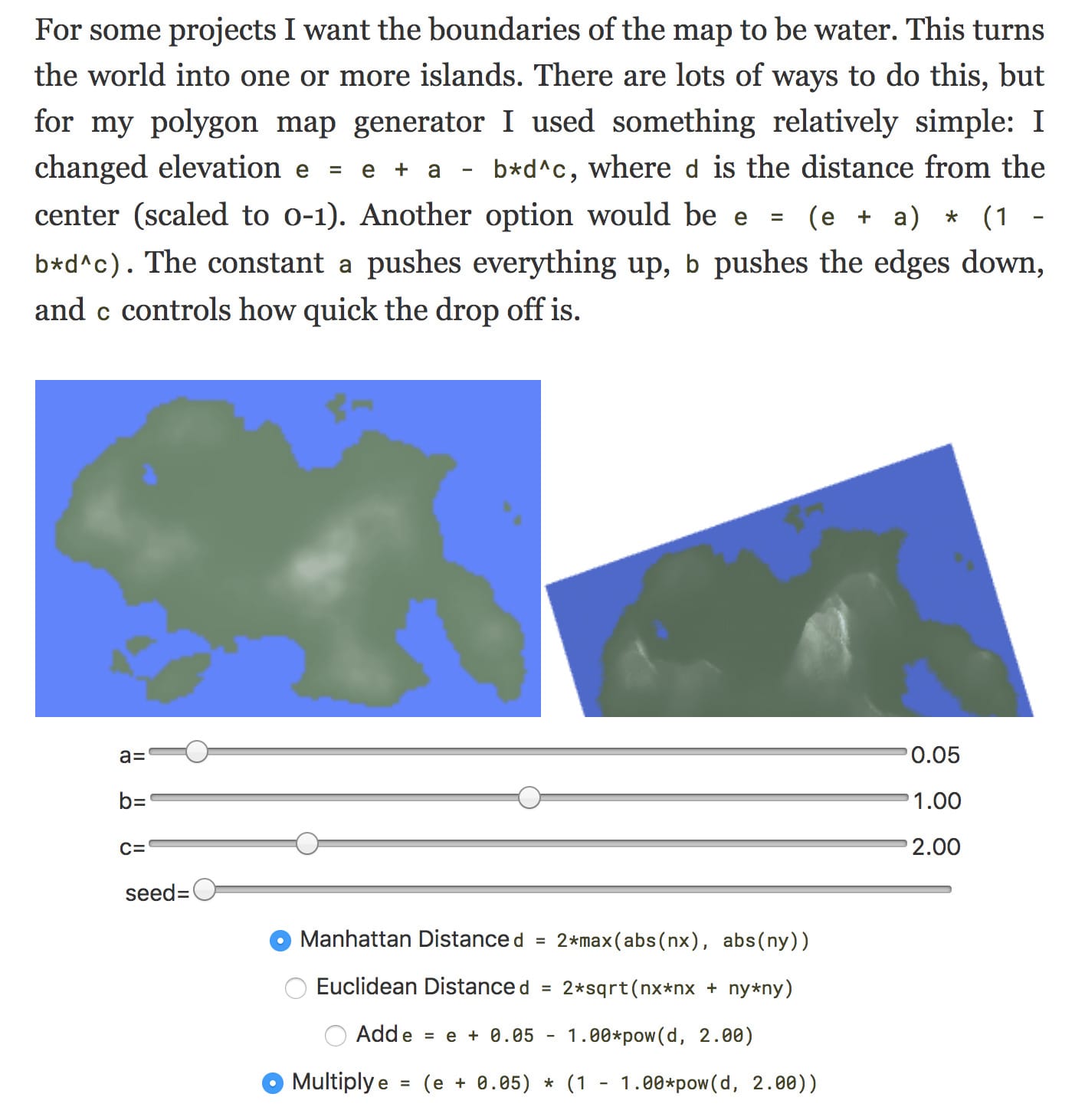
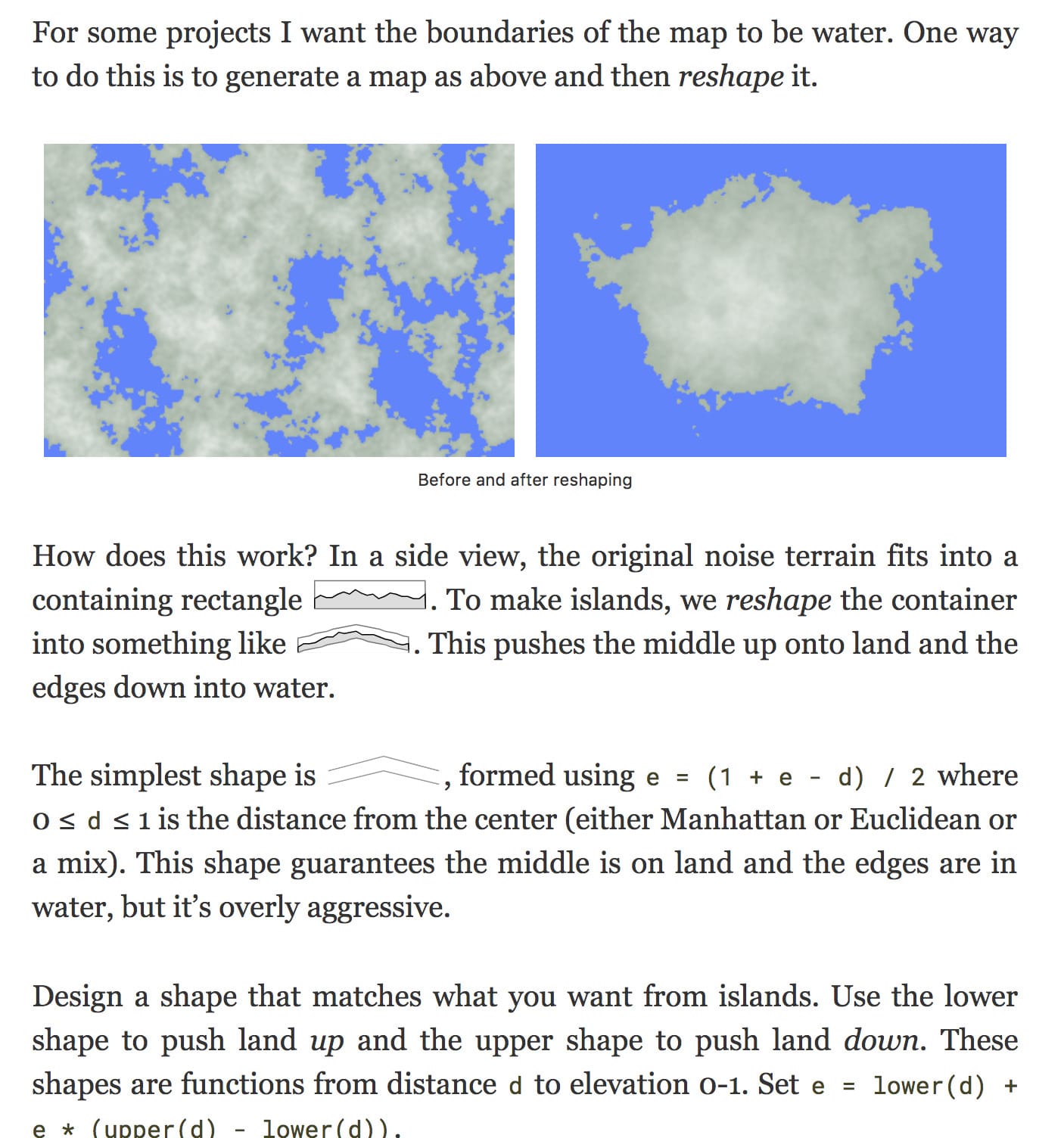
Improving Island Shaping For Map Generation
One of my goals for 2019 is to improve my existing pages. This week I improved the island map section of my noise-based map generation page.
I had offered lots of options: additive vs multiplicative, Euclidean vs Manhattan distance, and three mysterious parameters named a, b, c. It was simple for me to offer lots of options. The problem with lots of options is that there's a large "possibility space" to explore. You may or may not find something you like.
Based on feedback from readers, I decided to rewrite this section. I stepped back and thought about why we're adding and multiplying. What is the goal? How does it work?
- Push the edges of the map down into water. I need to decrease elevations near the edges.
- Push the middle of the map up onto land. I need to increase elevations near the middle.
The main idea is to start with noise-based elevation and reshape it into what we want. The noise-based elevation fits into a box , and we reshape the box into something like . The contents of the box, whatever terrain had been generated, will get pushed up and down when the box is changed.
I rewrote the entire section of the page to explain this idea, and I ended up removing the interactive diagram.
Related: Why Minimal Guidance During Instruction Does Not Work says that experts can use the interactive exploration to navigate the possibility space because they have already built up the intuition to know where to go. Novices on the other hand learn better with guidance.
jueves, 19 de marzo de 2020
Seguidores
Archivo del blog
-
►
2025
(61)
- ► septiembre (2)
-
►
2024
(60)
- ► septiembre (1)
-
►
2020
(388)
- ► septiembre (5)
-
►
2019
(1129)
- ► septiembre (156)
-
►
2018
(50)
- ► septiembre (2)
-
►
2017
(171)
- ► septiembre (6)
-
►
2016
(141)
- ► septiembre (14)
-
►
2015
(111)
- ► septiembre (9)
-
►
2014
(78)
- ► septiembre (4)
-
►
2012
(799)
- ► septiembre (56)
-
►
2011
(1028)
- ► septiembre (69)